
Morphological Fingerprint Feature Extraction: Noise Suppression and Structure Enhancement Based on Bowler-Hat Transform
This project implements a mathematical morphology processing pipeline using MATLAB. It uses Top-Hat operations to filter background stains and introduces the Bowler-Hat Transform for structure enhancement. The results show improved readability of contaminated fingerprint ridges and provide an additional validation case for line-structure image processing.
Fingerprint images and ultrasound vascular images share high topological similarity (both are tubular/linear structures), but also face the same problems of background noise (stains) and insufficient contrast.
🛑 The Problem
In the preprocessing stage of fingerprint recognition, we commonly face the following challenges:
- Background Noise: Stains, ink unevenness, or sensor contamination during acquisition create irregular block noise on the image (as shown in the large-area stains in the left image).
- Weak Structure: Low contrast between fingerprint ridges and valleys causes traditional binarization methods (like Otsu’s method) to produce breaks or adhesions.
Our goal is to remove low-frequency background noise while enhancing high-frequency texture, preserving fingerprint details.
🛠️ Technical Deep Dive
The core concept of this project is viewing fingerprints as “terrain” - ridges are peaks, valleys are troughs, and stains are gentle slopes. We use Mathematical Morphology to separate these features.
1. Morphology Fundamentals and Structuring Element
Using MATLAB’s Image Processing Toolbox, I first defined the Structuring Element (SE, $B$). To match the physical characteristics of fingerprints, $B$ was designed slightly larger than typical ridge width to ensure correct texture capture.
2. Noise Removal: Top-Hat Operations
To remove large-area background stains (low-frequency noise), I used Top-Hat operations.
White Top-Hat (WTH): Extracts features that are brighter than surroundings and smaller than the structuring element (i.e., bright details/ridges). $$WTH(f) = f - (f \circ B)$$ (Where $\circ$ represents the Opening operation)
Black Top-Hat (BTH): Extracts features that are darker than surroundings and smaller than the structuring element (i.e., dark details/valleys). $$BTH(f) = (f \bullet B) - f$$ (Where $\bullet$ represents the Closing operation)
Through these two operations, we can “peel away” local bright and dark spots from the uneven background.
3. Structure Enhancement: Bowler-Hat Transform
Simple Top-Hat often only retains partial information. To simultaneously enhance ridges (bright) and valleys (dark) while maximizing contrast between them, I implemented the Bowler-Hat Transform (BHT).
Referencing Meftah et al. (2018), the standard BHT definition is White Top-Hat minus Black Top-Hat:
$$BHT(f) = WTH(f) - BTH(f)$$
Expanding this:
$$BHT(f) = [f - (f \circ B)] - [(f \bullet B) - f]$$
Physical Meaning:
- $WTH(f)$ contributes “positive features” (ridges) in the image.
- $BTH(f)$ contributes “negative features” (valleys) in the image.
- The subtraction operation ($WTH - BTH$) mathematically maximizes local contrast while canceling out slow variations in the background (i.e., removing stains), resulting in clean, high-contrast texture structure.
📊 Results & Validation
The figure below shows the algorithm’s processing results:
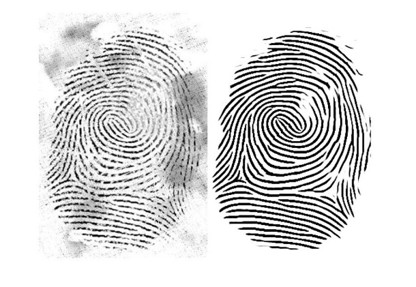 Figure 1: Fingerprint enhancement before-after comparison. Left: Original image with severe stains and noise; Right: Result after Bowler-Hat Transform and binarization.
Analysis Results:
- Noise Reduction: The large-area blur stains in the top-left corner and edges of the original image were removed. This is because the geometric scale of these stains exceeds our defined structuring element $B$, so they were treated as background and filtered out in Top-Hat operations.
- Structure Enhancement: The spiral structure (Whorl) at the fingerprint center became more visible, and ridge continuity and separation improved, showing that BHT is useful for line-structure enhancement.
Conclusion
This project uses morphological techniques to reduce noise interference in fingerprint extraction. It also serves as a validation set for observing how my vascular enhancement algorithm behaves on other images with line-like or tubular structures.