
Morphological Fingerprint Feature Extraction: Noise Suppression and Structure Enhancement Based on Bowler-Hat Transform
This project implements an advanced mathematical morphology processing pipeline using MATLAB. Through Top-Hat operations to filter out background stains, and introducing Bowler-Hat Transform for structure enhancement. Experimental results confirm that this algorithm can effectively restore ridge features of contaminated fingerprints while also validating the algorithm’s versatility for image processing in different domains.
Fingerprint images and ultrasound vascular images share high topological similarity (both are tubular/linear structures), but also face the same problems of background noise (stains) and insufficient contrast.
🛑 The Problem
In the preprocessing stage of fingerprint recognition, we commonly face the following challenges:
- Background Noise: Stains, ink unevenness, or sensor contamination during acquisition create irregular block noise on the image (as shown in the large-area stains in the left image).
- Weak Structure: Low contrast between fingerprint ridges and valleys causes traditional binarization methods (like Otsu’s method) to produce breaks or adhesions.
Our goal is to remove low-frequency background noise while enhancing high-frequency texture, preserving fingerprint details.
🛠️ Technical Deep Dive
The core concept of this project is viewing fingerprints as “terrain” - ridges are peaks, valleys are troughs, and stains are gentle slopes. We use Mathematical Morphology to separate these features.
1. Morphology Fundamentals and Structuring Element
Using MATLAB’s Image Processing Toolbox, I first defined the Structuring Element (SE, $B$). To match the physical characteristics of fingerprints, $B$ was designed slightly larger than typical ridge width to ensure correct texture capture.
2. Noise Removal: Top-Hat Operations
To remove large-area background stains (low-frequency noise), I used Top-Hat operations.
White Top-Hat (WTH): Extracts features that are brighter than surroundings and smaller than the structuring element (i.e., bright details/ridges). $$WTH(f) = f - (f \circ B)$$ (Where $\circ$ represents the Opening operation)
Black Top-Hat (BTH): Extracts features that are darker than surroundings and smaller than the structuring element (i.e., dark details/valleys). $$BTH(f) = (f \bullet B) - f$$ (Where $\bullet$ represents the Closing operation)
Through these two operations, we can “peel away” local bright and dark spots from the uneven background.
3. Structure Enhancement: Bowler-Hat Transform
Simple Top-Hat often only retains partial information. To simultaneously enhance ridges (bright) and valleys (dark) while maximizing contrast between them, I implemented the Bowler-Hat Transform (BHT).
Referencing Meftah et al. (2018), the standard BHT definition is White Top-Hat minus Black Top-Hat:
$$BHT(f) = WTH(f) - BTH(f)$$
Expanding this:
$$BHT(f) = [f - (f \circ B)] - [(f \bullet B) - f]$$
Physical Meaning:
- $WTH(f)$ contributes “positive features” (ridges) in the image.
- $BTH(f)$ contributes “negative features” (valleys) in the image.
- The subtraction operation ($WTH - BTH$) mathematically maximizes local contrast while canceling out slow variations in the background (i.e., removing stains), resulting in clean, high-contrast texture structure.
📊 Results & Validation
The figure below shows the algorithm’s processing results:
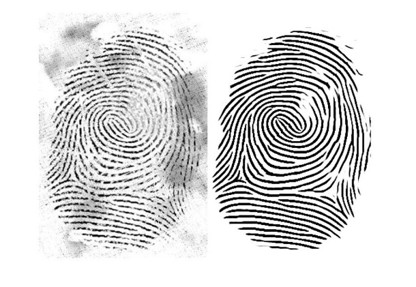 Figure 1: Fingerprint enhancement before-after comparison. Left: Original image with severe stains and noise; Right: Result after Bowler-Hat Transform and binarization.
Analysis Results:
- Noise Reduction: The large-area blur stains in the top-left corner and edges of the original image were successfully removed. This is because the geometric scale of these stains exceeds our defined structuring element $B$, so they were treated as background and filtered out in Top-Hat operations.
- Structure Enhancement: The spiral structure (Whorl) at the fingerprint center became clearly visible, and ridge continuity and separation significantly improved, proving BHT’s effectiveness in enhancing tubular structures.
Conclusion
This project successfully used morphological techniques to solve noise interference problems in fingerprint extraction. More importantly, it served as a validation set, proving that my developed vascular enhancement algorithm has strong robustness and cross-domain application potential, capable of effectively processing various biomedical images with “tubular structure” characteristics.